
Dress Fabrics & Details
Every dress begins as a length of cloth and a set of decisions. This library is a reference to both: the dress fabrics that give a garment its weight, drape and surface — from satin, chiffon, georgette and crepe to breathable cotton and linen — and the garment construction details that turn flat fabric into shape.
Read it slowly, compare the swatches, and return whenever you want to understand why a dress looks, feels and moves the way it does.
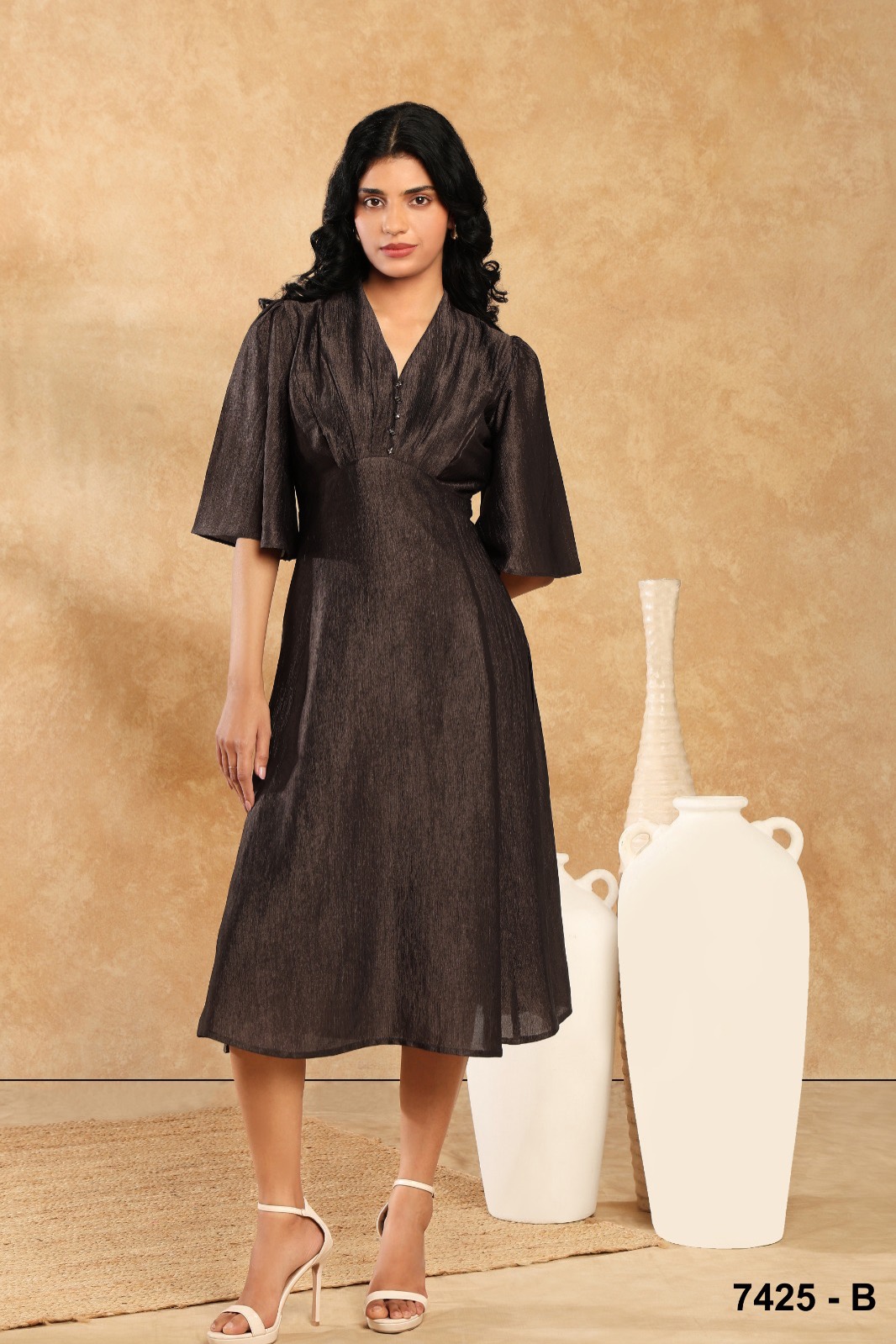
A ×3 Flutter-sleeve edge — the crinkled finish breaks the light into fine ridges.
B ×3 Skirt surface — panel seams and a vertical texture that lengthens the line.
The library of cloth
Ten fabrics, catalogued like an archive. Each entry pairs a woven-pattern swatch with four qualitative meters — weight, drape, sheen and breathability — on a five-step scale. These are general characteristics of each fabric type, not measurements: a particular cloth can sit higher or lower depending on its fibre, weave and finish.
-
Cotton
Plant fibre · plain, twill or knit
- Weight
- Medium (3 of 5)
- Drape
- Structured (2 of 5)
- Sheen
- Matte (1 of 5)
- Breathability
- Very high (5 of 5)
Cotton is the plant fibre most of us understand by touch: soft, absorbent and dependable. Woven plainly it becomes poplin, voile, cambric or mulmul; twilled it becomes drill or denim; knitted it becomes jersey. The surface is matte, and the hand ranges from crisp to brushed-soft depending on the finish. Cotton drapes with body rather than fluidity, so it holds a gathered skirt away from the legs and keeps a shirt collar standing.
Its great strength is breathability — the fibre absorbs moisture and lets air pass, which is why cotton dresses remain the default for humid Mumbai days. It creases, softens with washing and can shrink if it has not been pre-treated. Common applications: shirt dresses, tiered sundresses, smocked bodices, printed day dresses and linings. Style crisp poplin with structured sandals and a woven bag; let fine voile layer over a slip in the evening. Care: wash cool, reshape while damp, dry in the shade to protect colour and press while slightly moist for the cleanest finish.
-
Linen
Flax stalk fibre · plain weave
- Weight
- Medium (3 of 5)
- Drape
- Structured (2 of 5)
- Sheen
- Soft glow (2 of 5)
- Breathability
- Very high (5 of 5)
Linen is spun from the stalk of the flax plant, and its long, uneven fibres give the cloth its signature slub — the small thick-and-thin irregularities you can see and feel across the weave. It has a dry, cool hand and a natural low sheen that becomes softer and more lived-in with every wash. Linen is stiffer than cotton when new, so a linen dress stands slightly away from the body and keeps an architectural line; over time it relaxes.
It is among the most breathable fabrics there are and it dries quickly, which makes linen dresses a sensible choice for heat and humidity alike. The trade-off is creasing: linen wrinkles readily, and the wrinkles are part of its character. Linen–cotton and linen–viscose blends reduce this while keeping the look. Common applications: shift dresses, shirt dresses, wide-strapped sundresses and relaxed midis, styled with leather sandals, natural-fibre bags and minimal gold. Care: wash gently, avoid wringing, hang to dry and press damp with a hot iron — or simply embrace the crumple.
-
Satin
A weave · silk, polyester, acetate or viscose
- Weight
- Medium (3 of 5)
- Drape
- Fluid (4 of 5)
- Sheen
- High shine (5 of 5)
- Breathability
- Moderate (2 of 5)
Satin is a weave rather than a fibre. Long threads float over several others before tucking under, creating a smooth face that reflects light in one direction and a duller reverse. It can be woven from silk, polyester, acetate or viscose, which is why satins vary so widely in weight and hand. The defining quality is sheen: satin catches light along every fold, so drape, gathers and bias seams become visible as highlights and shadows.
Weight ranges from fluid charmeuse that skims the body to heavier duchess satin that holds a sculpted skirt. Because the surface is so smooth, satin shows every pull, press mark and uneven seam, so construction must be precise. Breathability depends on the fibre; synthetic satins feel warmer than silk ones. Common applications: slip dresses, cowl necklines, wrap midis and party wear — balance the shine with matte accessories and simple jewellery. Care: dry-clean structured pieces; hand-wash lighter ones cool, never wring, and press on the reverse with a low iron.
-
Silk
Protein fibre · many weaves
- Weight
- Light (2 of 5)
- Drape
- Fluid (4 of 5)
- Sheen
- Lustrous (4 of 5)
- Breathability
- High (4 of 5)
Silk is the protein fibre unwound from the cocoon of the silkworm, prized for its rare combination of strength, lightness and lustre. Under light it shows a soft, layered glow rather than a hard shine, because the fibre's triangular cross-section refracts light like a prism. Silk can be woven into many cloths — crepe de Chine, habotai, dupion, tussar, chiffon or satin — so its weight runs from almost weightless to crisp and slubbed.
It regulates temperature well, feeling cool in warmth and comfortable in air-conditioning, and it absorbs moisture without feeling damp. Silk drapes beautifully and takes deep, saturated colour, making it a favourite for evening dresses, bias-cut slips and festive wear. It is, however, sensitive to sunlight, perspiration, water spots and abrasion. Styling: keep it simple — the fabric is already the statement. Care: dry-clean structured or dupion silk; hand-wash washable silks in cool water with a gentle detergent, roll in a towel to remove water and press on the reverse at a low setting.
-
Chiffon
Sheer plain weave · high-twist yarn
- Weight
- Sheer (1 of 5)
- Drape
- Liquid (5 of 5)
- Sheen
- Soft glow (2 of 5)
- Breathability
- High (4 of 5)
Chiffon is a sheer, lightweight plain weave made from highly twisted yarns, which give the surface a faintly rough, matte texture and a remarkable lightness. It was originally woven in silk; today most chiffon is polyester, which is easier to look after. Chiffon floats: it moves at the slightest breath of air and falls in soft, liquid folds, which is why it is used so often for flutter sleeves, overlays, capes and tiered skirts.
Because it is translucent, a chiffon dress is almost always lined or layered — two or three layers build colour depth without adding weight. It is breathable but delicate, prone to snagging and fraying, and difficult to sew, so seams are usually French-seamed and edges finished with narrow rolled hems. Common applications: evening maxis, occasion dresses and soft day dresses for warm weather, paired with delicate footwear and jewellery that will not catch the fabric. Care: hand-wash cool or dry-clean, never wring, drip-dry on a hanger and press on low heat through a cloth.
-
Georgette
Crepe-twist plain weave · semi-sheer
- Weight
- Light (2 of 5)
- Drape
- Fluid (4 of 5)
- Sheen
- Matte (1 of 5)
- Breathability
- High (4 of 5)
Georgette is chiffon's slightly heavier, more opaque cousin. It is woven from tightly twisted crepe yarns in both directions, which produce a crinkled, pebbly surface, a dull matte finish and a springy hand. That twist gives georgette bounce: it drapes fluidly yet recovers its shape and resists creasing better than chiffon. It is less sheer, though lighter colours may still need a lining.
Silk georgette is luxurious; polyester georgette is widely used because it holds print well, washes easily and travels without crushing. Its fall makes it a natural choice for flowing midis, wrap dresses, gathered sleeves, anarkali-inspired silhouettes and printed maxi dresses that need to move without clinging. It breathes reasonably well, especially in natural fibres. Styling: block heels or flat sandals by day, metallic accents by night. Care: hand-wash or machine-wash gently in a laundry bag, avoid high heat and press lightly on the reverse — georgette rarely needs much ironing.
-
Crepe
Textured family · twisted yarn or finish
- Weight
- Medium (3 of 5)
- Drape
- Fluid (4 of 5)
- Sheen
- Matte (1 of 5)
- Breathability
- Good (3 of 5)
Crepe describes a family of fabrics with a crinkled or grainy surface, created by highly twisted yarns, a special weave or a finishing process. The result is a matte, slightly textured face that diffuses light, so colours look rich but never glossy. Crepe ranges from light crepe de Chine to substantial wool or polyester crepes with a heavy, elegant fall.
Its weight and drape make it a tailor's favourite: it follows the body without clinging, holds darts and princess seams cleanly and resists wrinkling. That combination explains why crepe is so often chosen for sheath dresses, workwear, structured midis and refined evening columns. Breathability is moderate and depends on the fibre — viscose and silk crepes feel cooler than polyester ones. Crepe can fray and some qualities shrink in hot water. Styling: sharp footwear and structured bags emphasise its clean line. Care: follow the label closely; many crepes prefer cool hand-washing or dry-cleaning, and a low iron used through a pressing cloth.
-
Organza
Sheer, crisp plain weave
- Weight
- Sheer (1 of 5)
- Drape
- Crisp (1 of 5)
- Sheen
- Low lustre (3 of 5)
- Breathability
- Good (3 of 5)
Organza is a sheer, crisp plain weave traditionally made from silk and now often from polyester. Like chiffon it is transparent, but where chiffon floats, organza stands. Tightly twisted yarns and a firm finish give it a papery, wiry hand and a slight lustre that turns almost iridescent when the warp and weft are dyed in different colours.
Organza holds volume without weight, so it is used to build sculptural sleeves, puffed shoulders, ruffles, overlays and structured skirts — and as an interlining that stiffens other fabrics invisibly. It breathes because it is so open, but it can feel scratchy against skin, which is why it is usually layered over a softer lining. It frays and shows every stitch, so it calls for clean, narrow seams. Common applications: occasion and evening wear, where an organza layer adds drama while keeping the dress light; let polished, simple accessories support its architecture. Care: dry-clean or hand-wash very gently, never crush and press with a cool iron through a cloth.
-
Velvet
Cut-pile weave · silk, viscose or synthetic
- Weight
- Heavy (5 of 5)
- Drape
- Balanced (3 of 5)
- Sheen
- Lustrous (4 of 5)
- Breathability
- Limited (1 of 5)
Velvet is a pile fabric: an extra set of yarns is woven in and cut so that short, dense fibres stand up from the base cloth. That pile absorbs and reflects light at once, so velvet shows deep colour in the shadows and a soft glow on the raised surfaces — it appears to change shade as you move. It is the heaviest fabric in this library and the warmest, with a plush hand and a weighty, swinging drape, especially in silk–viscose blends.
Velvet flatters a simple silhouette; long sleeves, wrap fronts, clean bodice seams and column skirts all gain richness. Breathability is limited, so in Mumbai it belongs to air-conditioned evening events, cooler months and travel to colder places. The pile bruises under pressure and should not be crushed, ironed flat or hung on narrow hangers. Styling: minimal metallic jewellery and sleek footwear — the surface is the ornament. Care: dry-clean, steam rather than press, and store hanging with space around it.
-
Polyester blends
Synthetic fibre · blended with cotton, viscose or elastane
- Weight
- Medium (3 of 5)
- Drape
- Balanced (3 of 5)
- Sheen
- Low lustre (3 of 5)
- Breathability
- Moderate (2 of 5)
Polyester is a synthetic fibre, and it is at its most useful when blended — with cotton, viscose, elastane or wool — to borrow the strengths of each. Blends reduce creasing, improve shape retention, help prints stay vivid and make fabrics quicker to dry and easier to care for. Polyester can also imitate other cloths convincingly: polyester satin, georgette, crepe and chiffon make up much of contemporary dress fabric, so weight, drape and sheen depend entirely on how the yarn is constructed.
The main limitation is breathability. Polyester does not absorb moisture the way cotton or linen do, so a high-polyester dress may feel warm in humid weather; blends with cotton or viscose, open weaves and loose silhouettes help. Common applications: travel dresses, workwear, printed midis and occasion dresses that need to look fresh after hours of wear. Care: usually machine-washable on a gentle cycle; avoid high heat, which can glaze the surface, and press on a low setting.
Anatomy of a dress
Turn a dress inside out and its construction becomes visible. This drawing maps twelve details found across contemporary dresses. Select a number to jump to its explanation, or read the list in order — from the neckline down to the finish of the cloth itself.
-
Neckline construction
The neckline frames the face and sets the tone of the whole dress, but its clean edge is engineered. Most necklines are finished with a facing — a shaped piece of fabric stitched to the edge and turned inside — or with a narrow bias binding that bends smoothly around curves. V-necks are stay-stitched before construction so their bias edges do not stretch, and deep or crossover necklines are often stabilised with fine tape so they lie flat against the body. Collars gain structure from interfacing, while cowl necklines rely on bias-cut fabric that falls into soft folds. A well-built neckline sits close without gaping or rolling outwards, from the first wearing to the fiftieth.
-
Sleeve designs
Sleeves change a dress's proportions more than almost any other detail. A set-in sleeve is eased into the armhole for a clean, tailored shoulder; a raglan sleeve runs diagonally to the neckline for a softer slope; a kimono or dolman sleeve is cut in one with the bodice for an easy, relaxed line. Volume is built through gathers, pleats or a wider pattern piece: puffed sleeves gather at the head or cuff, while flutter and bell sleeves widen from the elbow so they move as the arm moves. Cuffs, elastic channels and buttoned plackets finish the wrist. Lighter fabrics give flutter sleeves their float; crisper ones help puffed sleeves hold their shape.
-
Darts
A dart is a stitched, tapering fold that turns flat fabric into a three-dimensional shape. Bust darts point towards the fullest part of the chest; waist darts remove width between bust and hip; back darts follow the curve of the shoulder blades. They are the quiet reason a fitted bodice sits smoothly rather than pulling. A dart must taper to nothing at its point, or it leaves a small bubble. In patterned fabric, darts are placed to keep motifs balanced, and in fluid fabrics such as satin they are pressed carefully so they do not leave a shine mark. Where a design prefers a long seam, darts are often absorbed into princess lines.
-
Pleats
Pleats are folds of fabric stitched or pressed in place to control fullness. Knife pleats all face one direction for a crisp, directional swing; box pleats fold away from each other for structured, tailored volume; inverted box pleats hide the fold beneath for a cleaner front. Sunray and accordion pleats are heat-set into synthetic fabrics so the whole skirt fans open and closes as you walk. Pleats can also be released partway — stitched down from the waist and opening below the hip — which keeps the waist neat while freeing the hem. The fabric decides the character: cotton pleats look sharp and graphic, georgette pleats soften into ripples.
-
Tucks
Tucks are narrow folds stitched along their full length, usually on the right side of the fabric, so they become decoration and structure at once. Pin tucks — only a few millimetres wide — are grouped in parallel rows on bodices, yokes and cuffs; wider tucks above a hem add weight and a subtle horizontal rhythm. Released tucks behave like small darts, stitched for a short distance and then opening into soft fullness. Because they use up fabric, tucks are planned before cutting. On fine cottons and voiles they create a clean, heirloom-like texture; on heavier fabrics they read as graphic lines that echo the structure of the dress.
-
Seams
Seams are the joins that hold a dress together, and where they sit shapes how it fits. Side and shoulder seams carry the structure; princess seams curve from the shoulder or armhole through the bust to shape the body without darts; centre-front and centre-back seams allow shaping along the spine or a bias-cut skirt. Inside, raw edges are finished to stop fraying — overlocked for everyday wear, French-seamed for sheer fabrics, bound for unlined pieces. Outside, a seam can disappear or become a feature: topstitched, piped or trimmed. In the tunic pictured here, a single vertical seam down the front is outlined with a fine contrast trim, turning construction into ornament.
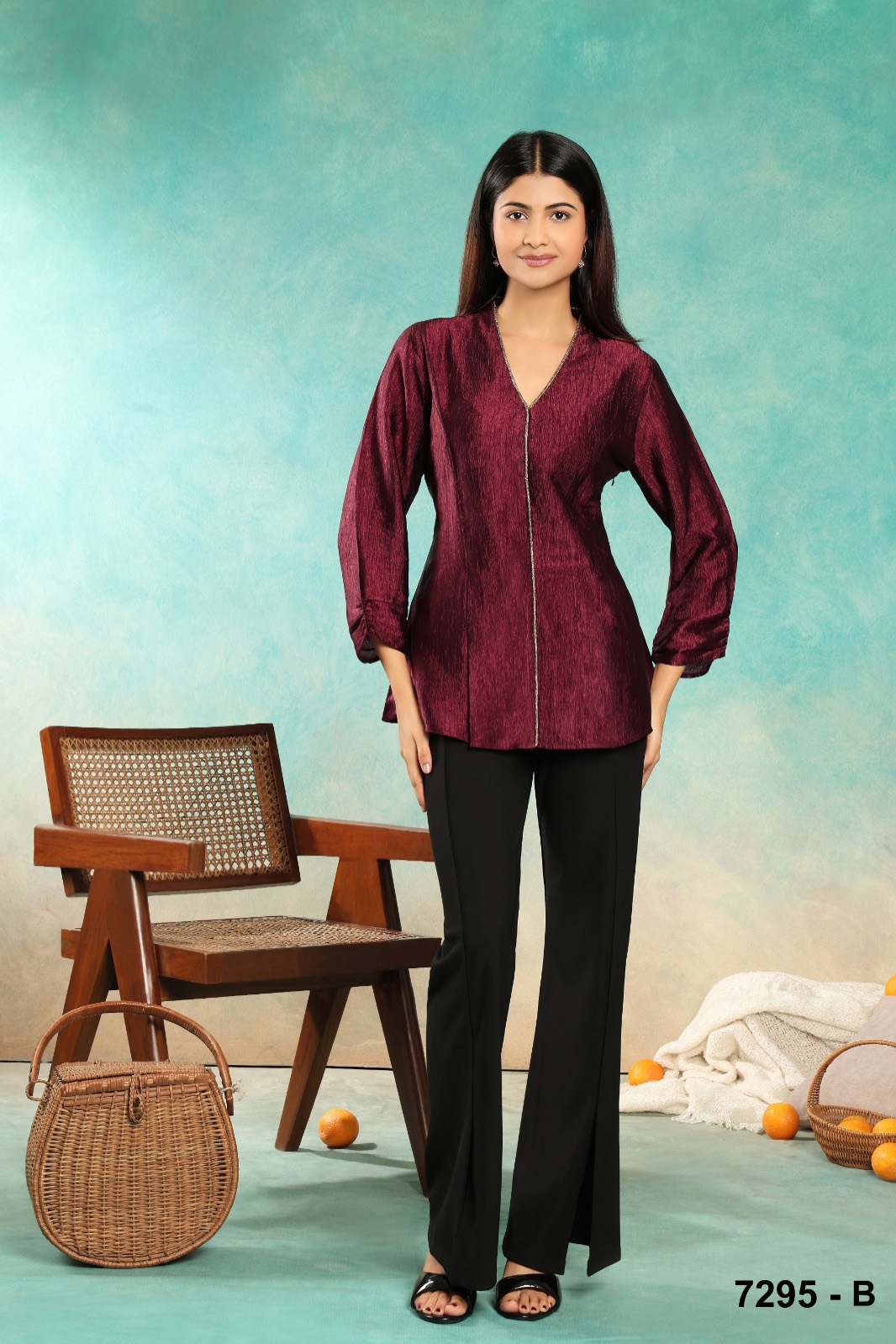
Fig. 17 A burgundy tunic worn over black flared trousers: one vertical front seam, outlined with a fine contrast trim, runs from the notched V-neckline to the hem, and the long sleeves finish in turned-back cuffs. See also 10 — Closures. -
Linings
A lining is a second, lighter layer sewn inside a dress. It lets the dress glide over the body, keeps sheer fabrics modest, stops seams and darts from showing through and helps the outer fabric hang smoothly and keep its shape. Linings are often cotton, voile, viscose or a smooth synthetic; in a hot, humid climate, a breathable natural lining makes a real difference to comfort. A lining may be full, cover only the bodice or stop above the knee, and a free-hanging lining is cut slightly shorter than the dress so it never peeps below the hem. Under chiffon and georgette, the lining also adds colour depth beneath the sheer layer.
-
Hems
The hem finishes the lowest edge of the dress, and its depth and method affect how the skirt hangs. A deep, blind-stitched hem adds weight and makes a skirt fall cleanly; a narrow rolled hem keeps chiffon and georgette light and floating; a faced hem suits curved or shaped edges; a horsehair braid stiffens an evening skirt into a soft flare. Bias-cut dresses are left to hang before hemming, because the fabric drops unevenly. Visible machine hems suit casual cottons and denim, while invisible hand-finished hems belong to tailored and occasion wear. A good hem is level, flat and invisible from the right side — unless it is meant to be seen.
-
Waist construction
The waist is where many dresses change direction — from fitted bodice to released skirt — and its construction defines the silhouette. A natural waist seam joins bodice and skirt at the narrowest point; an empire seam sits just below the bust for a long, falling line; a dropped waist lowers the join towards the hip for a relaxed, linear shape. Waistbands add definition and are sometimes stiffened with interfacing; elasticated channels and smocking offer comfort and flexibility; drawstrings and self-ties let the wearer adjust the fit. Gathers, pleats or darts control how the skirt's fullness meets the waist, and a belt layered over the top can redraw any of these lines.
-
Closures
Closures make a dress wearable, and they can be hidden or celebrated. The invisible zip, set into a side or centre-back seam, gives a smooth, uninterrupted line and is the default for fitted dresses; an exposed zip becomes a design feature. Buttons and buttonholes open shirt dresses and front plackets, while small covered buttons with rouleau loops give cuffs and backs a couture-like finish. Hooks and eyes secure waistbands and neck edges; press studs hide on wrap fronts to stop them gaping. Ties and wrap fastenings let the wearer adjust the fit. Whatever the method, a closure should lie flat without pulling or puckering.
-
Embellishments
Embellishments add surface interest to the finished garment — or are worked into the fabric before it is cut. Embroidery ranges from fine thread motifs and chikankari to beads, sequins and mirror work; appliqué layers shaped pieces of fabric onto the dress; lace trims edge necklines, sleeves and hems; piping and contrast trims outline seams. Placement matters as much as technique: embroidery along a neckline draws the eye upwards, scattered motifs across a skirt add movement and trimmed seams emphasise length. Heavier embellishment needs a stable base fabric or a backing so it does not drag the cloth out of shape. Restraint usually reads as more contemporary than full coverage.
-
Surface finishes
A surface finish changes the appearance and hand of a fabric after it has been woven. Crinkle and crush finishes set a permanent texture; plissé and heat-set pleats press shape into synthetics; mercerising gives cotton a subtle lustre; peaching or sanding softens the face of a cloth; washing and enzyme treatments make linen and denim feel worn-in from the first day. Metallic foils, lurex threads and shimmer finishes catch the light, while matte finishes make colour look deeper. The textured dress at the top of this page shows a finish at work: its crinkled surface catches light unevenly, so a single dark colour reads as many tones.
How fabric and construction shape movement
A dress is designed standing still but lived in motion. The moment you walk, sit, turn or climb a flight of stairs, two forces take over: the physics of the fabric and the construction that tells it where to go. Understanding both is perhaps the most useful lesson a wardrobe can teach.
Fabric decides the quality of movement. Weight pulls a skirt downwards and gives it momentum, so velvet and heavy crepe swing in a slow arc and settle quickly. Light, high-twist yarns, as in chiffon and georgette, respond to the air itself, so a hem lifts and floats long after you have stopped. Crisp weaves such as organza, poplin and linen resist folding; they hold a shape away from the body and move as a single plane rather than in ripples. Sheen then records the movement: satin and silk turn every fold into a line of light, while matte crepe and cotton quietly absorb it.
Construction channels that behaviour. Darts and princess seams anchor the fabric close to the body where stability is wanted — across the bust, at the waist, over the shoulder blades. Below that anchor, the cut decides how freely the cloth is released. A straight-grain skirt falls in vertical lines; a bias cut lets the fabric stretch, cling and spiral; a circle skirt flares into the widest possible sweep. Gathers make soft, irregular movement; pleats make ordered, rhythmic movement that opens and closes with each step. Even the hem contributes: a deep hem steadies the swing, a rolled hem sets it free.
This is why the same silhouette can feel entirely different in two fabrics, and why a well-made dress simply feels easier to wear. When fabric and construction agree, the dress moves with you rather than against you. Next time you try on a dress, take a few steps, sit down, raise your arms — and watch what the cloth does. It will tell you more than the mirror.