
No. 04 — The programme · 19:00 to 00:00
Party & Evening Wear
Satin that holds the light, sequins that hold a room, and long lines that slow the whole evening down.
This is Options Mall's guide to party wear dresses in Mumbai and the quieter art of evening dresses for women — how cocktail dresses differ from gowns, why a satin dress behaves the way it does under lamplight, and when a sequin dress or a one-shoulder dress is the right answer to an invitation.
Read the programme- A Fluid satin, gathered at the waist
- B Flutter sleeve, open and light
- C Midi hem that moves with each step
The evening changes the rules
Daylight forgives almost everything. Evening light does not. It is lower, warmer and more directional, it bounces off some surfaces and disappears into others, and it turns a room into a series of pools and shadows. A dress chosen for the evening is really a dress chosen for that light.
That is why party and evening wear has its own vocabulary. Fabrics with a sheen — satin, charmeuse, lamé, a crepe-backed satin — pick up candles and fairy lights and send them back. Textured surfaces such as sequins, beading, metallic jacquard and fil coupé catch light in fragments. Darker grounds read as rich rather than heavy, and long, unbroken lines look deliberate in a way they rarely do at noon. The cut, too, can be bolder: a bare shoulder, a deep back, a hem that sweeps or stops short.
The programme below runs through twelve kinds of party and evening dress as if they were acts in a single night. Some belong at the start of the evening, some belong at midnight, and many move comfortably between the two. Read it as a reference, not a rulebook.
The programme
An evening in twelve dresses. Doors 19:00 — Carriages 00:00
-
Contemporary party dresses
The contemporary party dress is the most open category of all, and that is its charm. It borrows freely — a shirt collar on a satin slip, a cut-out at the waist, a pleated skirt below a knitted bodice, an asymmetric hem that dips at one side. What unites these dresses is a sense of play: they are designed to be noticed but not to be solemn. For a house party, a gallery opening or a friend's rooftop evening in Bandra, a contemporary party dress lets personality lead. Look at proportion first, then one unexpected detail, and keep everything else simple.
-
Cocktail-inspired styles
Cocktail dresses were born for the early part of the evening — the hour of drinks before dinner — and they still carry that brisk, polished energy. The classic cocktail length sits around the knee or just below it, the silhouette is defined (sheath, fit-and-flare, a neat A-line), and the fabric has enough body to hold its shape while you stand and talk. Today the term is loose: a cocktail-inspired dress might be a midi in crepe with a sculpted neckline, or a short structured dress in jacquard. The common thread is tidiness: a clean outline, a considered neckline, and nothing that needs constant adjusting.
-
Statement dresses
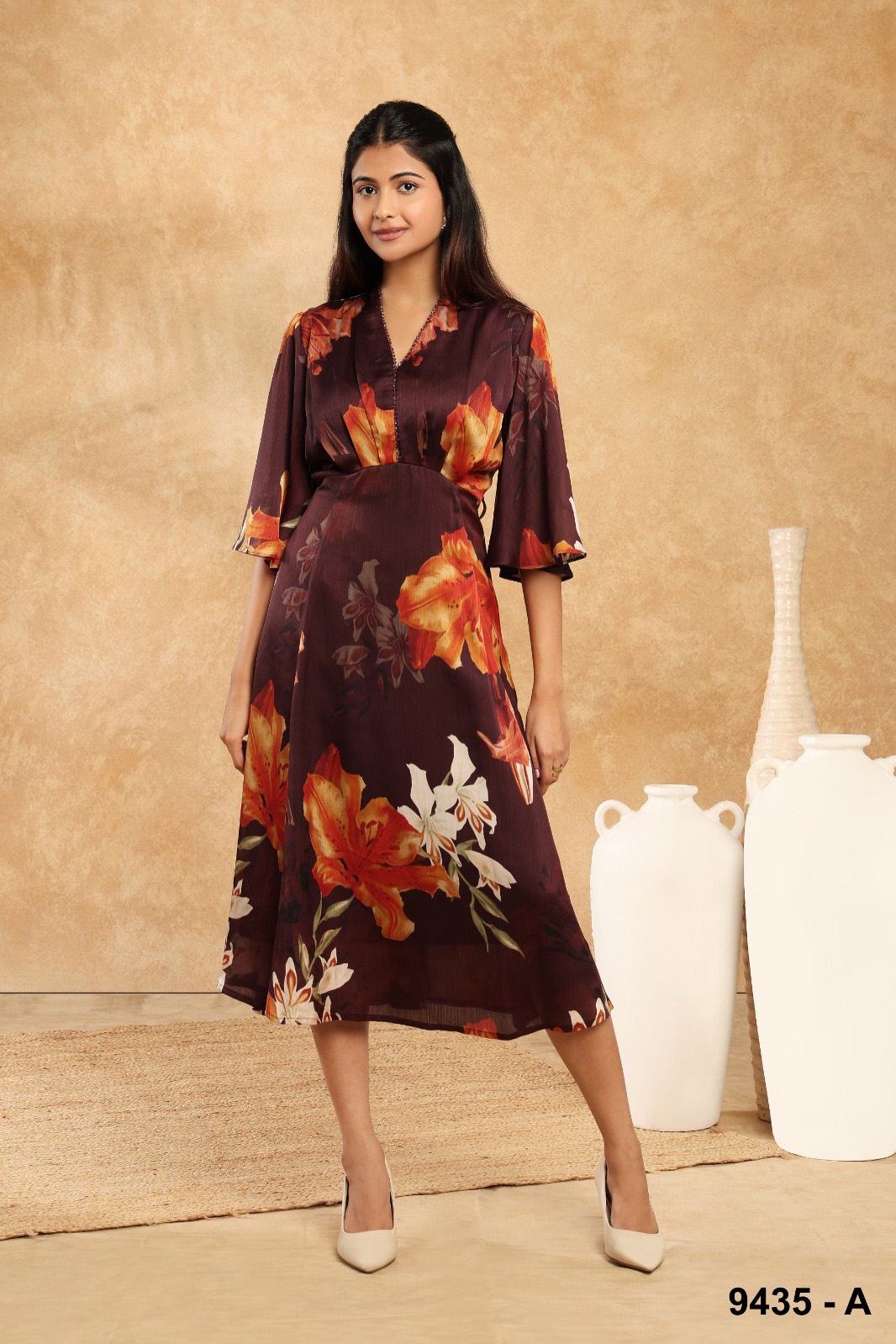
A statement dress is built around one decision made loudly. It might be colour — a full-strength fuchsia, emerald or tangerine — or scale, as in a print large enough to read from across a room, like the oversized lilies on burgundy satin pictured above. It might be volume: a balloon sleeve, a tiered skirt, a dramatic bow at the shoulder. The discipline lies in letting that one idea speak. When the dress is the headline, accessories become footnotes: fine jewellery, a quiet clutch, footwear in a tone drawn from the dress itself. A statement dress works best when everything around it agrees to step back.
-
Elegant evening dresses
Elegance in evening wear is mostly a matter of restraint and line. Elegant evening dresses tend to favour fluid fabrics — silk satin, georgette, crepe, chiffon over a lining — cut long enough to move in a slow, continuous way. Necklines are deliberate rather than busy: a soft cowl, a clean V, a boat neck that frames the collarbones. Colour is often deep and single, so that the shape is what you notice. This is the dress for a formal dinner, a reception, a concert or a wedding evening where the hours are long and the setting is dressed up. The aim is ease: a dress that looks composed at the first course and still looks composed at the last.
-
Embellished dresses
Embellishment is any decoration applied to the surface of a dress after the cloth is woven: beads, sequins, crystals, embroidery, appliqué, metallic thread, feathers or fringe. In evening wear it adds weight, sparkle and craft. Placement changes everything. Embellishment concentrated at a neckline draws the eye upward and frames the face; scattered across a skirt it creates movement; outlining a waist or a seam emphasises the construction. Heavier work needs a fabric strong enough to carry it, and a lining to stop beads catching on skin. A lightly embellished dress can be worn many ways; a heavily worked one deserves a simple setting.
-
Satin dresses
Satin is a weave rather than a fibre: long floating threads on the surface create a smooth face that reflects light in one direction. It can be woven from silk, polyester, viscose or blends, and its weight ranges from a liquid charmeuse to a stiff duchess satin. A satin dress therefore behaves in two very different ways. Lightweight satin cut on the bias skims and pools; heavier satin holds structure and stands away from the body. Under evening light, satin glows along every curve and fold, which is why simple cuts suit it best. It does mark with water and creases with heat, so a short steam before leaving helps.
Plum, black & the art of the pair
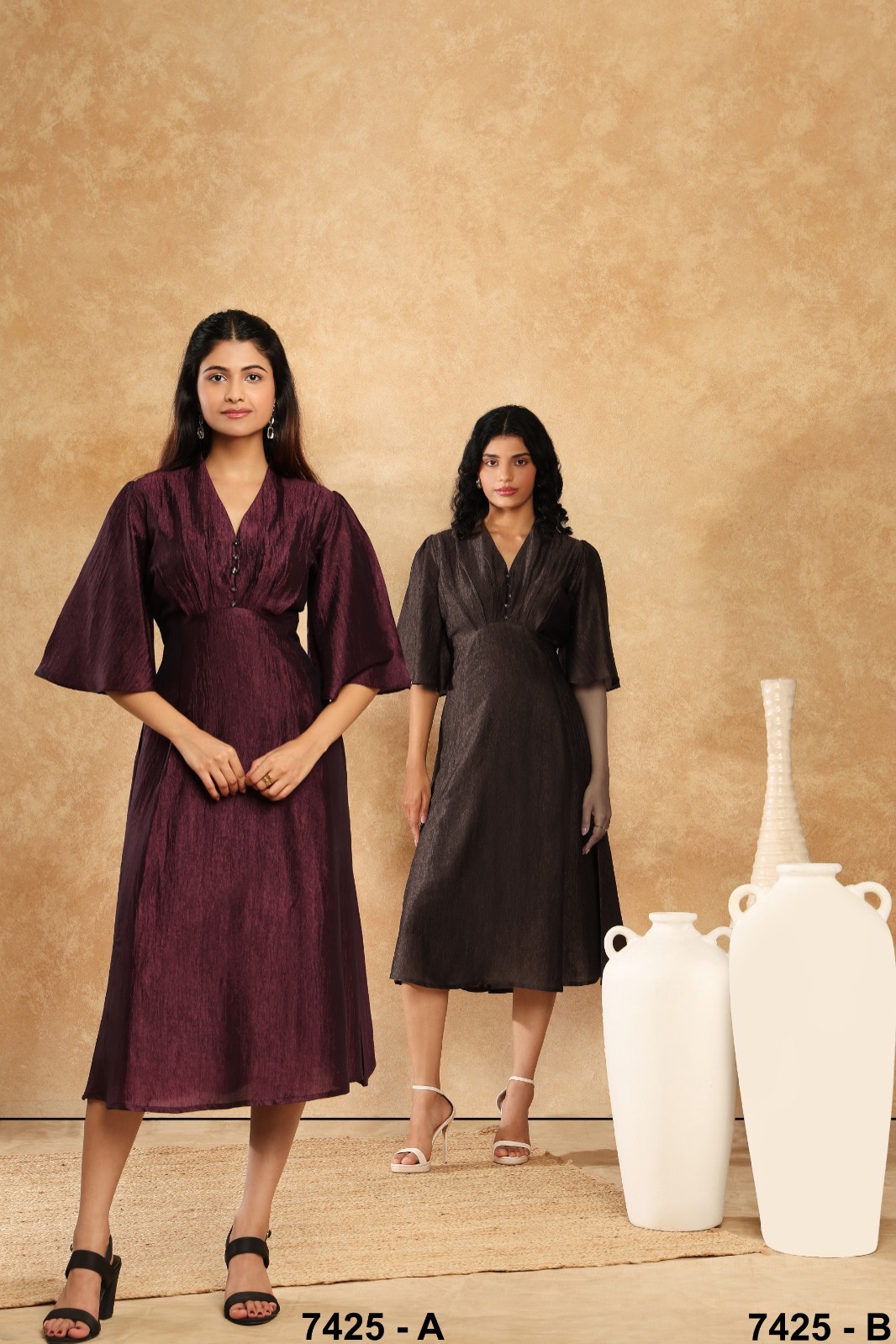
Halfway through the programme, a pause to look at two colours that belong to the evening. Plum is one of the most reliable evening shades there is: deep enough to look rich in low light, warm enough not to feel severe, and flattering beside gold and silver alike. Black is its natural partner — the colour that gives every silhouette a crisp edge and lets texture do the talking.
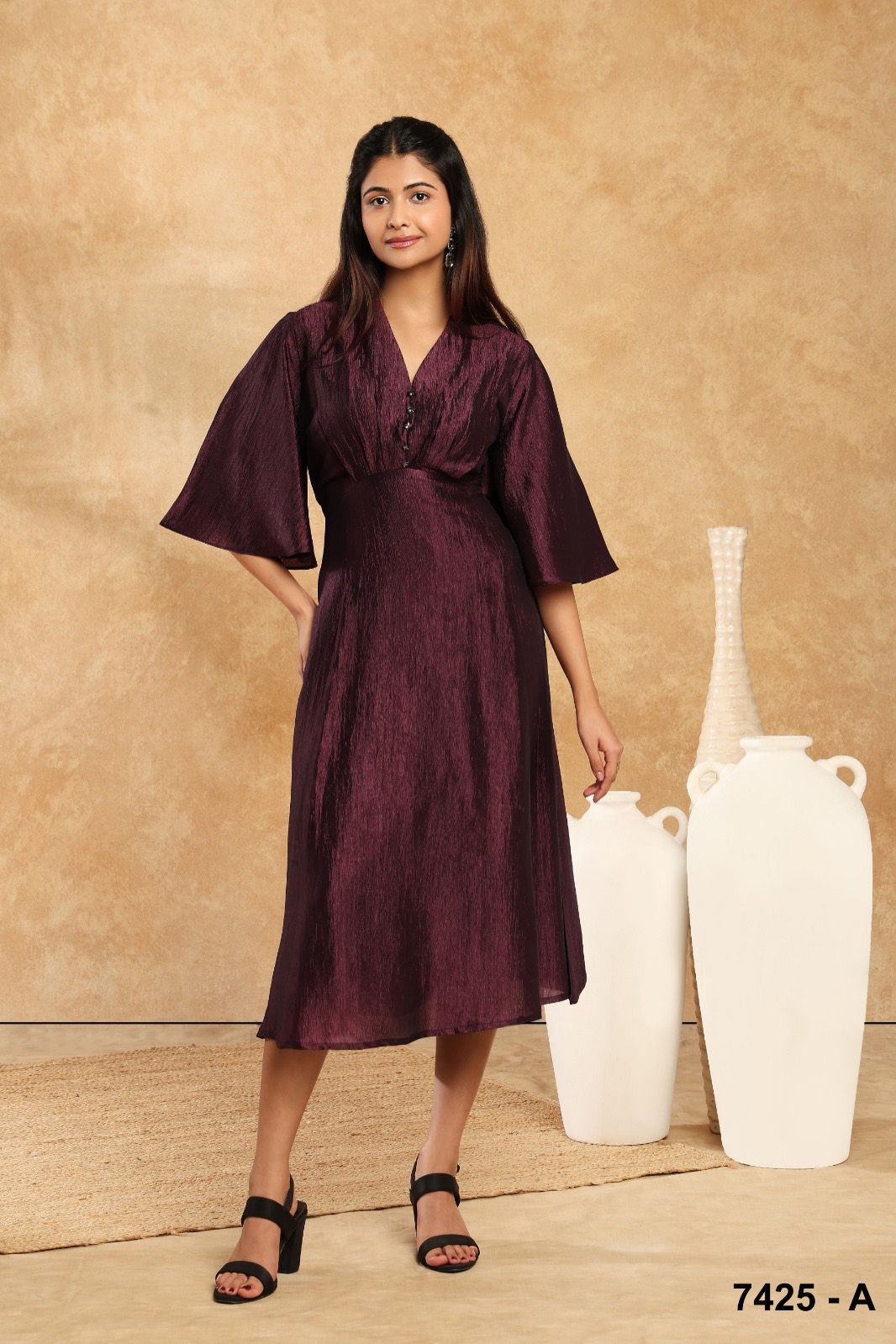
The two dresses opposite share a mood but not a shape. One relies on wide flutter sleeves and a fluid skirt; the other on a wrap bodice that defines the waist. Side by side they show how a single colour story can hold two very different personalities — useful to remember when you are dressing alongside a friend, a sister or a partner for the same occasion.
Notice, too, how a satin-finish surface turns plum from flat to luminous where the fabric curves. That sheen is the subject of the next act.
The programme, continued
-
Sequin and textured dresses
Sequins are the most literal way to catch light: each disc is a tiny mirror, and together they turn movement into shimmer. A sequin dress is at its best when the room is dim and the music is on. Matte sequins, tonal sequins sewn onto a matching base, or sequins confined to a single panel give a more restrained effect than an all-over metallic. Texture beyond sequins counts here too — lurex knits, crinkled lamé, velvet, metallic jacquards, cloqué with its blistered surface. Textured dresses add interest without needing pattern, so they pair well with very plain accessories. Check seams and underarms for comfort before committing to a long night.
-
Draped silhouettes
Drape is what fabric does when it is allowed to fall, fold and gather under its own weight. A draped dress uses that behaviour as design: a cowl that collapses softly at the neckline, a twist at the hip, a sarong-like wrap across the body, or a Grecian column of pleats. Draping needs a fabric with fluidity — jersey, georgette, crepe de chine, lightweight satin — and good construction underneath so that the folds stay where they were placed. The result flatters through movement and shadow rather than tight fit, which makes draped silhouettes one of the most comfortable ways to look dressed up for an entire evening.
-
One-shoulder designs
A one-shoulder dress cuts a single diagonal line from one shoulder across the body, and that asymmetry does a lot of work. It draws the eye upward, shows the collarbone and the line of the arm, and makes even a simple column feel architectural. The covered shoulder may carry a sleeve, a ruffle, a knot or a sculpted strap; the bare one benefits from minimal jewellery so that the line stays clean. Earrings matter more than necklaces here. Because the neckline is the statement, one-shoulder designs work in solid colours and quiet textures, and they adapt across lengths — from short cocktail versions to full-length evening gowns.
-
Off-shoulder designs
The off-shoulder or Bardot neckline sits horizontally across the upper arms, leaving both shoulders and the collarbone open. It is a softer, more romantic line than the one-shoulder and it creates width at the top of the body, which balances a fuller or longer skirt. The construction matters: a well-made off-shoulder dress has elastic, boning or a fitted band so that it stays in place while you move and raise your arms. Necklaces sit beautifully in that open frame, and hair worn up shows the line at its best. A light wrap or a structured jacket is useful for cooler air-conditioned venues.
-
Elegant long dresses
A floor-length or ankle-length dress is the clearest signal that an evening is formal. Elegant long dresses work by keeping the line unbroken from shoulder to hem: column, sheath, A-line or a softly flared gown. Slits make walking and dancing easier and add movement; trains add ceremony but need space. The hem length should be judged with the shoes you will actually wear, so that the fabric just skims the floor or the ankle. In Mumbai, lighter long dresses in georgette, chiffon or crepe are practical for warm evenings, while heavier satin and velvet suit air-conditioned halls and the cooler months.
-
Contemporary short dresses
Midnight belongs to the short dress. Above-the-knee hems are easier to dance in, lighter to carry through a long night and naturally modern in feel. Contemporary short dresses play with structure — a sculpted mini in neoprene or bonded crepe, a slip dress in satin, a tiered skirt that swings, a blazer dress with a sharp shoulder. Because the length is brief, proportion becomes important: a fuller sleeve or a higher neckline balances a short hem, and footwear takes a bigger role in the overall look. Short dresses also welcome stronger surfaces, so this is a natural moment for sequins, metallics and bold colour.
The details
A glossary of the decisions that separate a good party or evening dress from a merely shiny one — fabric and surface, the shape of the neckline and sleeve, length, colour, and everything you wear with it. For a deeper look at weaves and finishes, visit the fabrics and details library.
-
Fabric selection
Evening fabrics are chosen as much for how they move and reflect as for how they feel. Satin and charmeuse give sheen and fluidity; crepe gives a matte, grainy surface with a heavy, flattering fall; georgette and chiffon add sheer, floating layers; velvet absorbs light and looks deep and plush. Weight matters as much as fibre. A heavier fabric holds a structured silhouette and hangs straight; a lighter one follows the body and catches air. In a warm climate, look for breathable linings and natural or blended fibres against the skin, even when the outer surface is synthetic or metallic.
-
Surface details
Surface is everything the eye reads before it reads shape: sheen, texture, print and weave. A jacquard carries its pattern in the weave itself, so it looks rich even in one colour. Fil coupé leaves cut threads that create a lightly feathered pattern. Cloqué puckers into a blistered relief, while crushed or plissé fabrics hold permanent creases that shimmer when they move. Burnout velvet combines sheer and dense areas in a single cloth. These surfaces give a plain silhouette depth without adding decoration, and they tend to photograph beautifully because they create their own small highlights and shadows.
-
Embellishments
Embellishment ranges from a single row of beads along a neckline to a dress worked entirely in sequins. Good embellishment is secure, evenly spaced and finished on the inside so it does not scratch. Think about where it will rub: heavy beading under the arms or at the inner wrist can be uncomfortable over a long night, and fringe on a hem catches on chairs. Tonal embellishment — sequins or beads in the same colour as the base — gives sparkle without loudness. When the dress is embellished, let accessories be plain, and choose a bag without a chain that could snag on the surface.
-
Neckline variations
The neckline frames the face and sets the formality of a dress. A V-neck lengthens the line of the neck and suits pendants; a square neck feels graphic and slightly vintage; a halter draws attention to the shoulders and works well with backless cuts; a cowl softens everything with drape; a high or mock neck feels modern and polished and asks for statement earrings rather than a necklace. Sweetheart and strapless necklines are romantic and formal but need solid internal structure. When choosing jewellery, follow the shape of the neckline rather than competing with it.
-
Sleeve designs
Sleeves change the silhouette more than people expect. A flutter sleeve, like the one on the plum midi, adds movement and softness at the shoulder. A puff or balloon sleeve adds volume and a playful, slightly historical feel. A long bishop sleeve gathered at the cuff looks romantic and covers the arm for cooler venues. Cap sleeves are neat and modest; spaghetti straps are minimal and make the bodice the focus. Bell and cape sleeves bring drama to an otherwise simple dress. Choose sleeves with the evening in mind: you will raise a glass, hug people and dance, so check movement in front of a mirror.
-
Dress lengths
Length sets the tone faster than anything else. Short and mini dresses read young, energetic and party-ready. Knee-length is classic cocktail. Midi lengths, falling between knee and ankle, are the most versatile for evenings because they look dressed up without being formal, and they pair with heels, block heels or embellished flats. Ankle-length and floor-length dresses suggest ceremony. When an invitation says formal or black tie, a long dress is the safe reading; when it says cocktail, anything from knee to midi works. High-low hems combine two lengths and add movement as you walk.
-
Colour considerations
Evening light is warm and dim, so colours behave differently after sunset. Deep jewel tones — emerald, sapphire, ruby, amethyst, plum — hold their saturation in low light where paler shades turn grey or muddy. Metallics such as gold, silver, bronze and gunmetal reflect whatever light there is, so they read even in a dark room. Black works because it gives a sharp, clean outline against any background and lets texture show. A monochrome look, with dress, shoes and bag in one family of colour, creates a long uninterrupted line. Brights and pastels still work, but choose those with a sheen so they glow rather than fade.
-
Footwear and accessory coordination
Begin with the hem. Long dresses need shoes that set the hem at the right height; short dresses make the shoes part of the silhouette. Strappy sandals keep the look light; pointed pumps sharpen it; block heels and embellished flats are kinder for long standing evenings. Match metals across shoes, bag and jewellery for a calm, finished effect. A small clutch or a structured mini bag suits evening proportions better than a large tote. Choose one focal accessory — earrings, a cuff or a statement bag — and keep the rest quiet. A wrap or tailored jacket in a matching tone completes the outline for air-conditioned venues.
-
Day-to-evening transitions
Many evenings begin straight after work, so a dress that can move from day to night is valuable. Start with a simple base — a black, navy or deep-toned midi in crepe or satin — and change what surrounds it. Swap a blazer or denim jacket for a fine wrap; trade flats or loafers for heeled sandals; replace a work tote with a small clutch; exchange stud earrings for drop earrings or a statement pair. Add a bold lip or a metallic belt to sharpen the waist. Loosen your hair or put it up. The dress stays the same; the context around it changes completely.
Where the night leads next
Party and evening wear sits within a wider wardrobe. Continue with the occasions that call for it, the fabrics that make it work, and the history behind it — or visit us in Juhu, Vile Parle West.
- OccasionsOccasion & celebration dressesBirthdays, family functions, dinners and formal events — read the dress code.
- MaterialFabrics & details librarySatin, crepe, georgette and the construction behind evening dresses.
- Journal 07The Evolution of Party and Evening WearHow party and evening dressing developed into today's styles.
- VisitContact Options MallFind us at Vile Parle Shopping Centre, V.M. Road, Juhu, or call +91 8369381345.